1. Code Library
In [1]:
HTML("""<style>
@import url('https://fonts.googleapis.com/css?family=Orbitron|Roboto');
body {background-color: gainsboro;}
a {color: seagreen; font-family: 'Roboto';}
h1 {color: slategray; font-family: 'Orbitron'; text-shadow: 4px 4px 4px #aaa;}
h2, h3 {color: darkslategray; font-family: 'Orbitron'; text-shadow: 4px 4px 4px #aaa;}
h4 {color: slategray; font-family: 'Roboto';}
span {text-shadow: 4px 4px 4px #ddd;}
div.output_prompt, div.output_area pre {color: darkslategray;}
div.input_prompt {color: seagreen;}
div.output_stderr pre {background-color: ghostwhite;}
div.output_stderr {background-color: gainsboro;}
</style>""")
Out[1]:
In [ ]:
# jupyter notebook --NotebookApp.iopub_data_rate_limit=2147483647
In [43]:
Pkg.resolve()
In [110]:
# Pkg.clone("http://github.com/cormullion/Astro.jl")
In [7]:
using PyCall, PyPlot
using SymPy, LaTeXStrings
using DataFrames, RDatasets
In [15]:
using GR, Plotly
using Interact, Plots
using Winston, Astro
In [9]:
using UnicodePlots
using Distributions, QuantEcon
In [10]:
using GLVisualize, Colors
using GeometryTypes, Reactive
In [14]:
# init_notebook(true)
2. Data
In [16]:
days = DateTime(2016,1,1,0,0,0):DateTime(2016,12,31,0,0,0);
eq_values=Float64[equation_time(Dates.datetime2julian(day)) for day in days];
In [17]:
head(RDatasets.datasets(), 20)
Out[17]:
In [18]:
titanic = dataset("datasets","titanic")
head(titanic, 10)
Out[18]:
In [51]:
x = [1.2,3.5,5.8,8.2,10.5,12.2,15.6,17.3,18.9,20.1]
y = [0.8 2.1 4.2 5.7 6.5 7.9 9.6 11.3 15.6 19.9]

x1, y1, z1 = [1,3,5], [0,0,0], [0,0,0]
dx1, dy1, dz1 = [1, 1, 1], [3, 3, 3], [5, 3, 7]

x2 = [2,3,4]
y2 = [1,3,5]
z2 = [[2,1,1], [3,3,8], [4,5,5]]

numbers = rand(10,4)
equation(numbers) = -5 * tan.(numbers) + 10 * tan.(3*numbers + 100);
In [20]:
Θ = linspace(0,6π,200)
Out[20]:
In [21]:
writedlm("test.txt", numbers)
numbers = readdlm("test.txt")
Out[21]:
In [22]:
vectors = ([-3, 2], [4, 3], [1, 5])
x_array = zeros(2, length(vectors))
y_array = zeros(2, length(vectors));
In [23]:
labels = []
for l = 1:length(vectors)
    vector_label = vectors[l]
    x_array[2, l] = vector_label[1]
    y_array[2, l] = vector_label[2]

    labels = [labels; (1.1 * vector_label[1], 1.1 * vector_label[2], "$vector_label")]
end
In [24]:
labels
Out[24]:
3. Maths
In [30]:
@vars a b c
Out[30]:
In [26]:
p=expand( (a+1)*(a-2)*(a^2-10) )
Out[26]:
In [27]:
factor(p)
Out[27]:
In [28]:
polyroots(p)
Out[28]:
In [29]:
map(N,SymPy.solve(p))
Out[29]:
In [16]:
fig1 = PyPlot.figure(figsize=(14,7))
surf(randn(20,20), cmap="bone", alpha=0.4);

In [13]:
bar3D(x1, y1, z1, dx1, dy1, dz1);

In [15]:
fig2 = PyPlot.figure(figsize=(14,7))
contour3D(x2, y2, z2, extend3d=true, stride=1, cmap="bone", alpha=0.5, w=3);

In [17]:
scatter3D(rand(10,10), rand(10,10), rand(10,10), marker="8", c="darkgreen", alpha=0.5);

In [19]:
fig3 = PyPlot.figure(figsize=(14,7))
csd(rand(100,100), rand(100,100), color="darkgreen")

Out[19]:
4.2 Plots
In [54]:
gr()
Out[54]:
In [71]:
Plots.plot(p, -4, 4, label="function (a+1) * (a-2) * (a^2-10)", size=(900, 400), w=2)
Out[71]:
In [72]:
Plots.plot([sin,cos], -5pi, 5pi, label=["sin","cos"], w=3, size=(900, 400))
Out[72]:
In [112]:
Plots.plot(eq_values, size=(900, 400), line=(2,:dash), label="line")
Out[112]:
In [113]:
pyplot()
Out[113]:
In [114]:
Plots.plot(x_array, y_array, arrow=true, color=:blue, size=(700, 500),
           legend=:none, xlims=(-5, 5), ylims=(-1, 7), title="Vector Addition",
           annotations = labels, xticks=-5:1:5, yticks=-1:1:7)
vline!([0], color=:black)
hline!([0], color=:black)
Out[114]:

In [124]:
Plots.plot(equation(numbers), xlims=(1, 10), ylims=(-450, 150), size=(900, 400))
Out[124]:

In [132]:
z = rand(20,3)
Plots.plot(z,xaxis=("XLABEL",(-5,30),0:2:20,:flip),yaxis=("YLABEL",:log10),
           background_color=RGB(0.4,0.4,0.4),
           leg=false,title="TITLE",size=(1250, 450))
hline!(mean(z,1) + rand(1,3),line=(2,:dash,0.7,[:lightblue :royalblue :blue]))
vline!([5,10,15], line=(2, :dash))
Out[132]:

In [45]:
Plots.scatter(rand(100), rand(100), leg=false,
              ms=20*rand(100), alpha=0.5, c=:darkgreen,
              xlims=(-0.1, 1.1), ylims=(-0.1, 1.1), size=(900, 400))
Out[45]:
In [39]:
plotly()
Out[39]:
In [49]:
Plots.plot(Θ,abs.(0.1 * randn(200) + sin.(3Θ)),proj=:polar, size=(900, 400), label="sin")
Plots.plot!(Θ,abs.(0.1 * randn(200) + cos.(3Θ)),proj=:polar, label="cos")
Out[49]:
In [52]:
Plots.plot(x, numbers, title="Title", label=["First Line" "Second Line" "Third Line" "Fourth Line"], size=(900, 400))
Out[52]:
In [53]:
start = Date(2015, 6, 21)
x4 = map(d -> start + Base.Dates.Day(d), 1:120)
y4 = 15 + randn(120) * 4
Plots.plot(x4, y4, title="A typical British Summer",size=(900, 400), label="temperature")
Out[53]:
In [54]:
unicodeplots()
Out[54]:
In [ ]:
Plots.plot(Vector[randn(100),randn(100) * 100],axis=[:l :r],ylabel="LEFT",yrightlabel="RIGHT")
In [ ]:
Plots.histogram(randn(1000),nbins=50)
4.3 UnicodePlots
In [146]:
mplt=lineplot([-1, 2, 3, 7], [1, 2, 9, 4], title = "Unicode Plot", name = "first line", canvas = AsciiCanvas,
              border = :ascii, color=:blue, width = 90)
lineplot!(mplt, [0, 4, 8, 10], [10, 1, 10, 1], color = :yellow, name = "second line")
Out[146]:
In [147]:
mplt2=densityplot(randn(1000), randn(1000), color = :blue, width = 90)
densityplot!(mplt2, randn(1000) + 1, randn(1000) + 2, color = :red)
Out[147]:
4.4 Other Packages
In [35]:
# Winston
Winston.plot(x, y, "g*")
Out[35]:

5. Animations
In [36]:
pyplot()
Out[36]:
In [37]:
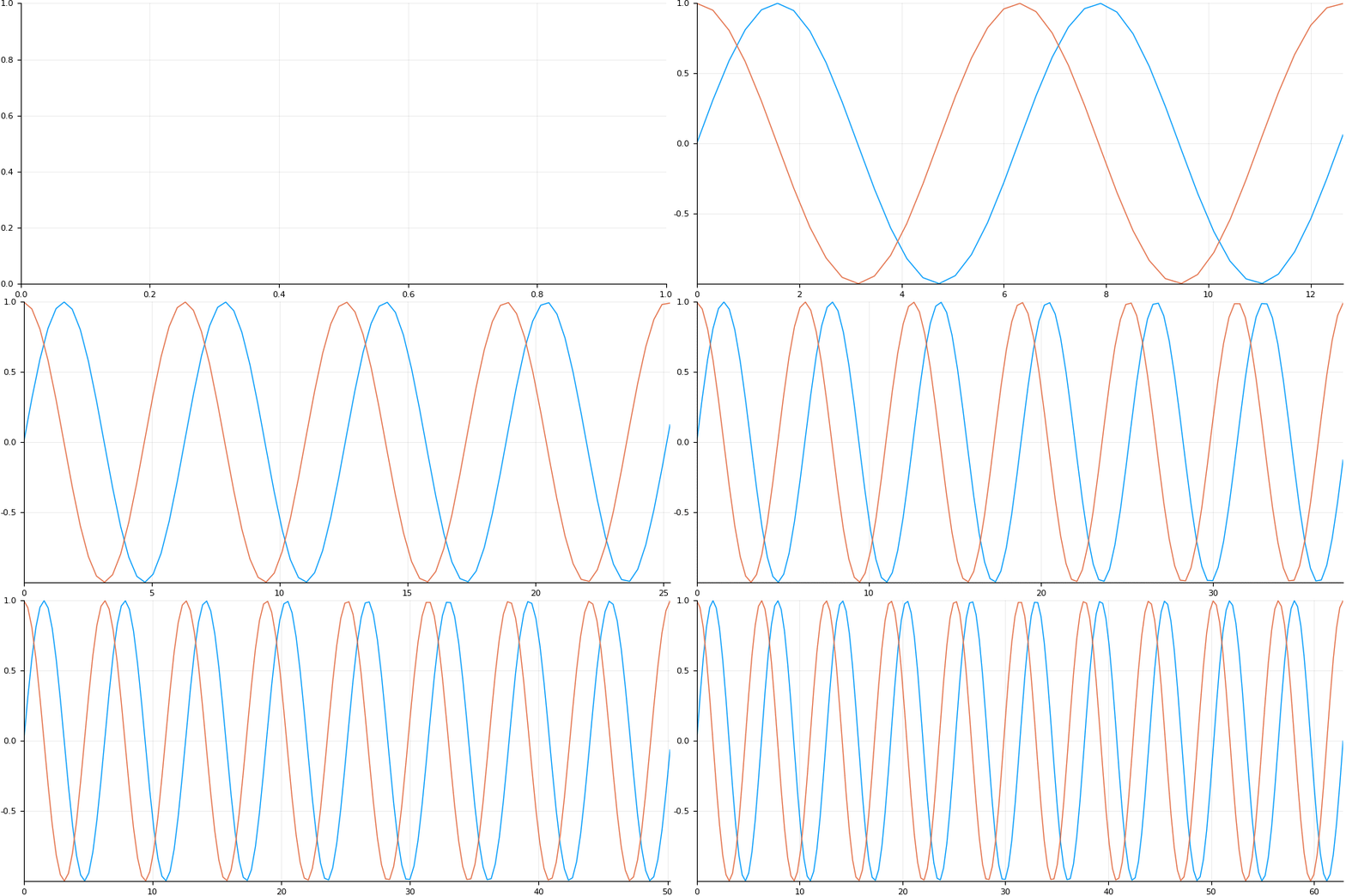
p1 = Plots.plot([sin,cos], zeros(0), leg=false, size=(900, 400));
anim1 = Animation();
for t = linspace(0,20π,200)
    push!(p1,t,Float64[sin(t),cos(t)])
    frame(anim1)
end;
gif(anim1, "anim1.gif", fps=15)

Out[37]:
In [38]:
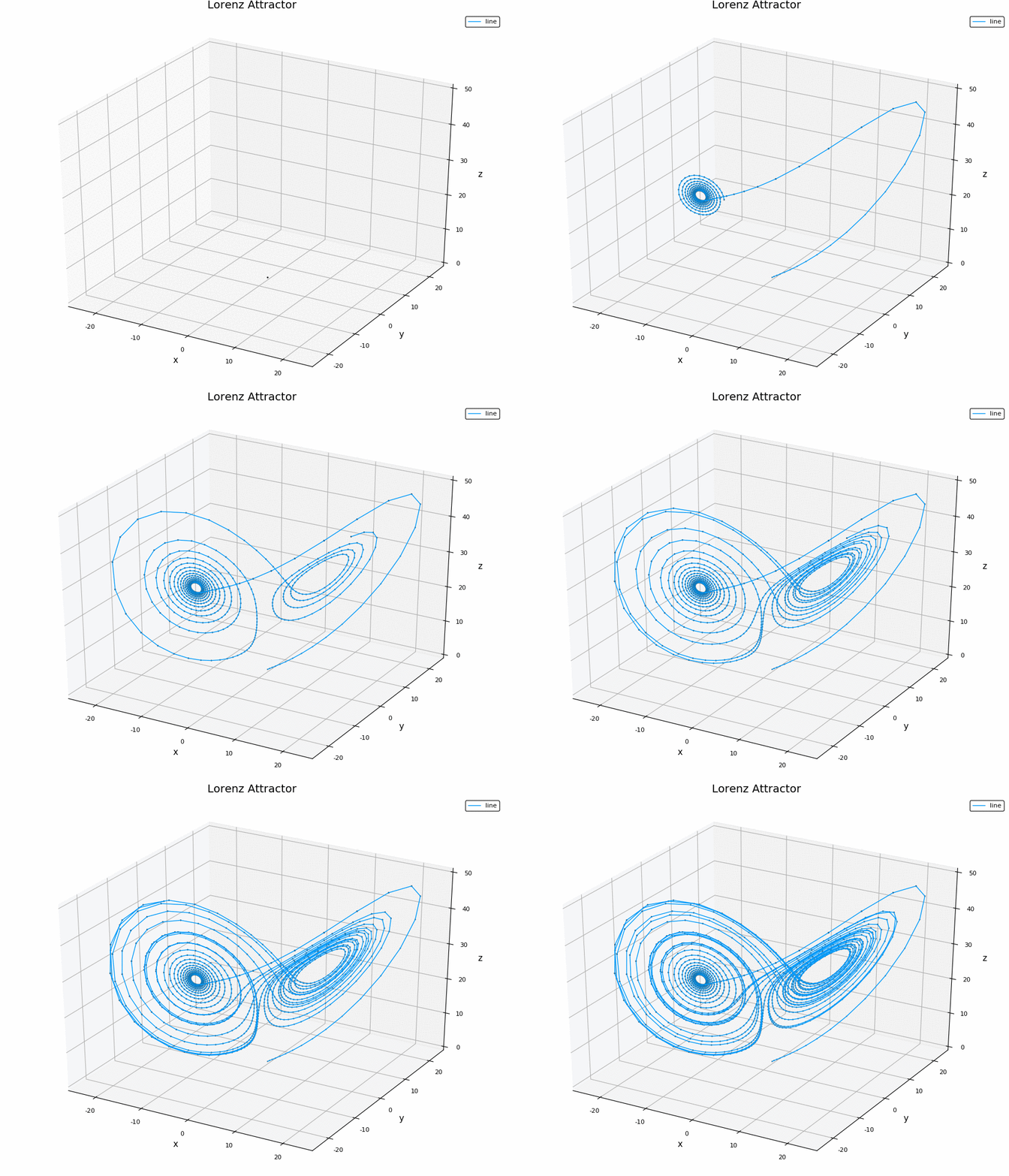
n = 1500
dt = 0.02
σ, ρ, β = 10., 28., 8/3
x, y, z = 1., 1., 1.

# initialize a 3D plot with 1 empty series
p2 = path3d(1, xlim=(-25,25), ylim=(-25,25), zlim=(0,50),
            xlab = "x", ylab = "y", zlab = "z", label="line",
            title = "Lorenz Attractor", marker = 1, size=(900, 700))

# build an animated gif, saving every 10th frame
@gif for i=1:n
    dx = σ*(y - x)     ; x += dt * dx
    dy = x*(ρ - z) - y ; y += dt * dy
    dz = x*y - β*z     ; z += dt * dz
    push!(p2, x, y, z)
end every 10

Out[38]:
6. Interactions
In [40]:
togglebutton(label="push"; value=true)
Out[40]:
In [41]:
dropdown(["one", "two", "three"])
Out[41]:
7. Quantitative Economics
In [42]:
P1 = [0.33 0.33 0.34; 0.1 0.8 0.1; 0.33 0.33 0.34]; MC1 = MarkovChain(P1)
Out[42]:
In [43]:
X1 = simulate(MC1, 100000); mean(X1 .== 1)
Out[43]: